Friday, December 16, 2011

How to Go from an Average Guitar Player to a Good Guitar Player . . .


First; It is great to be back writing to all of you again. I was discharged from Shady Grove Adventist Hospital last Saturday evening and now I’m home working on my physical rehabilitation and my general healing process, which should take a few months before I’m 100%.  I’m finally strong enough to start getting back into my music; at least by spending time writing to all of you and to continue my studies.  I’ll certainly be practicing my guitar several hours a day as soon as I can get that started. It will be a few more days before I can handle the weight of the guitar on my shoulder while sitting in bed or in a chair.  Until then, I’ll show you some photos of the hospital, the rehab center on the 4th floor that I was on and several other shots as time goes on in each of my posts.  Thanks again for all your prayers and support.

032     093

               Day #1 After Surgery               Day #4 After Surgery


026 (2)What I’ve learned over-the-years by following many accomplished guitarists is that most guitar players never really become good guitar players because they get hung-up on playing songs by reading tablature. Some of them may even start learning guitar theory thinking that is what will make them sound good. 

However, the truth is this; “after you’ve learned the fretboard, have gotten your hands used to playing the guitar, and have developed rhythm, it is time to immerse yourself into the music.” 

To do so, you must have a favorite style of music so you need to start getting into it and start learning to play that style music by using your ears.

Master the Art of Transcribing Music. This is done by listening to tracks and playing along with your guitar as best as you can. By taking the time to figure guitar songs out by ear you will sound much better. Guitar lessons can only teach you the basics. But it is up to you to develop a feel for music. For more tips check out these online guitar lessons.


003

Every day brings an opportunity to learn something new and get better at what we do.  These days I am aware of this in both my musical efforts and my physical ones, as I work on my rehab.  Never let an opportunity to learn pass you by!  You will never regret embracing one, but I promise that you will regret the ones that get away.  Hug your children, smile, and be happy. 

Until next time ~

Musician By Night . . .

MusicianByNight_01-Large

Friday, November 4, 2011

Watching Nik Kosmas [GC GARAGE] working on my 3-Color Sunburst, Highway One Fender Strat

Nik Kosmas at the GC GARAGE on 11-02-2011 004

I stopped in to see Nik today and get a first hand look at him working on my Highway One Fender Stratocaster.  He was getting it all cleaned up and preparing it for when the pickups  (Joe Barden S-Deluxe) come in. I purchased the GraphTech PS8000-00 String Saver Saddles and I brought a set of Fender Strap-Loks so that he could install them when he has the guitar on his bench.


DV019_Jpg_Regular_541530_001_942_blk_orange_both              711jpe4jVLS__AA1344_

My NEW Classic Fender Strat/Tele Hardshell Case (Black with a Dark Orange padded poodle plush interior) that I purchased from www.Musician’sFriend.com arrived today so my better half (Anita from http://sewvintagesofun.blogspot.com/) has offered to drop it off to Nik along with my NEW Levy's Veg Tan Leather (Cranberry) Guitar Strap.

Nik Kosmas at the GC GARAGE on 11-02-2011 003     Nik Kosmas at the GC GARAGE on 11-02-2011 006


My pickups should arrive early next week; when they get here, I’ll get them over to Nik right away so he can start the transformation of my  stock Fender Strat to a screaming, sweet sounding ax that plays like butter and has a beautifully outfitted, vintage guitar case much like that garage that you’d have to park your Porsche 911 Carrera S.

I wouldn’t trust anyone with my guitars but Nik.  I don’t know if you remember, I featured him and his company, GC GARAGE located inside The Guitar Center in Glen Burnie, MD.  He is a perfectionist; he handles each instrument with kid gloves.  Nik has experience with refinishing guitars as well as rebuilding them including all of the electronics.  During his tour in the US Air Force, he learned electrical engineering which has paved his way into becoming the best guitar technician in the Metro DC market.

Nik Kosmas at the GC GARAGE on 11-02-2011 001

Very soon, the plan is for Nik and I to take our music skills and merge them along with another guitarist/vocalist and/or a keyboardist/vocalist and hit the local market.  We have many plans including getting ourselves booked as an opening act for some of the big name acts coming thru the Baltimore/Washington area.   Hopefully we’ll have all of our guitars in tip-top shape before we are ready to play venues such as Rams Head in Annapolis, MD or the Blues Alley Jazz Club in Georgetown, DC. 

2005 Fender American standard Stratocaster 02     2005 Fender American standard Stratocaster 03     2005 Fender American standard Stratocaster 01

Once Nik finishes customizing my 3-Color Sunburst Highway One Strat for me, I may have another one in mind for him to start on.  I just stumbled upon a (blue) 2005 American Standard Stratocaster where the finish is all worn, scratched and nicked from heavy usage.  It reminds me of Stevie Ray Vaughan’s Signature Strat.  I showed it to Nik and he said that he did some work on that very guitar a while back.  For now, I’d leave it as is except for changing the saddles to the GraphTech String Saver’s and having Nik checking out the neck and the electronics to make sure everything is A-OK and changing the strings to my favorite, D’Addario Chromes, Half Rounds (0.011 thru 0.052).

GC Garage_001 


Chris Hauska is jammin' on the rhythm guitar at Tommy Joe's 07-02-08 022

I’ll keep you posted on my path to taking ‘MUSICIAN BY NIGHT’ LIVE along with Nik, who is an accomplished bass player/guitarist and another good friend of mine, consummate guitarist/vocalist, Chris Hauska.  Chris has played in a number of good rock & acoustic rock bands in the Baltimore/Washington Region.   I’ve even had the pleasure of filling-in at some of their gigs.  Chris’ voice is outstanding; a lot like Bruce Springsteen or Dave Matthews.


Here is ADAMS EDEN playing at Tommy Joe’s in Bethesda, MD on July 5th 2008; a 3-piece band that rocked that local after work hangout for many of the office personnel in the Bethesda Marketplace.

Chris Hauska is singing lead at Tommy Joe's 07-02-08 005  Bob (Squirrel) Janicki on lead guitar at Tommy Joe's 07-02-08 018A (4)  Chris Hauska is singing lead at Tommy Joe's 07-02-08 016


Now TGIF so enjoy your evening and especially, your weekend ahead.  If you’re into College Football, tomorrow night’s game will be a good one between #1 LSU and #2 Alabama.  The game’s on at 2:30PM EST; don’t miss it!  Of course keep practicing your scales and your chord patterns if you want to get better.

Until next time;

Musician By Night . . .

MusicianByNight_01-Large

Friday, September 9, 2011

What are Guitar Scales and how do I Use Them?

DSC01045

Using guitar scales is one of the most basic aspects of learning how to play a guitar. If you get a tight grip on your scales then there will be no stopping you. This article has been created to help you identify the different scales so that you can use them with ease.

instruments

Now that you have a guitar, you’re probably dying to play like a rock star. But you’ll have to practice before you can begin to play like Jeff Beck or Billy Gibbons. You’ll need to understand the different types of scales that are used in guitar playing and how they can influence each song. Let’s start with the major and minor scales first.

Major & Minor Scales

The major and minor scales in any guitar are always separated by 4 frets, which are known as the relative scales. They are called relative scales because all of them have one thing in common: the tone. The scale DO – RE – MI – FA – SO – LA – TI converts to LA – TI – DO – RE – MI – FA – SO, and vice versa.

Blue-Notes_LOGO

The major & minor scales are the backbone of Western music. It’s like a stepping stone, without which you would probably drown. Therefore, you need to go over the scales thoroughly and master both the major and minor before trying to move on to other scales. These scales are used universally, and mastering them will stand you in good stead. Once you master the major and minor scales, you will be able to widen your repertoire to increase the level of your stage performance.

Major Scale

DO – RE – MI – FA – SO – LA – TI – DO is a major scale. This is probably one of the most familiar scales in the world and most of us have heard it more than once since birth. One of the good things is that it creates a happy effect.

ATTRIBUTES:

Attributes
Values

Scale Formula
1-2-3-4-5-6-7

Step Construction
W-W-H-W-W-W-H

Distinguishing Degree
M7

Good over Chords
M , M7 , M6

Good with Progressions
I-IV-V , II-V-I , I-VI-IV-V , I-III-IV-I , I-IV-I , I-V-I

Minor Scale

MusicianByNight_03Small

LA – TI – DO – RE – MI – FA – SO – LA is a minor scale. It is basically the exact opposite of the major scale or rather when you read a major scale backwards, you get a minor scale. It is known as the minor because of the minor 3rd, while the distinguishing factor is the minor 6th. Both these scales have distinct effect on our emotions.

Other Scales

Guys_ScalesModesArpeggios

There are several other scales apart from the major scale and the minor scale and one of the most preferred or common scale is the pentatonic scale. The pentatonic scales are at the very core of most of the rock bands. It is used generously in blues and rock guitars and this is because they are easier to play. They are known as the forgiving scales because of the fact that the fingering of strings is quite straight forward. All Pentatonic scales are based on both the major and minor scales except for 2 specific notes, which are dropped. These notes get converted from pentatonic (five-note) to diatonic (seven-note).

In pentatonic scales, when you shift the tonality up in each step then you will get this:

1. DO – RE – MI – FA – SO – LA – TI – DO: Ionian

2. RE – MI – FA – SO – LA – TI – DO – RE: Dorian

3. MI – FA – SO – LA – TI – DO – RE – MI: Phrygian

4. FA – SO – LA – TI – DO – RE – MI – FA: Lydian

5. SO – LA – TI – DO – RE – MI – FA – SO: Mixolydian

6. LA – TI – DO – RE – MI – FA – SO – LA: Aeolian

7. TI – DO – RE – MI – FA – SO – LA – TI: Locrian

Now that you have understood the basic scales, it is time for a warm-up session on your guitar!

Related Articles:

Learning basic scales is extremely important, as I stressed in my earlier lessons.  I play my major scales at the beginning of every practice session then follow up with the pentatonic and blues scales towards the end.  This allows me to cover a wide variety of scales in my daily workout without getting stale or bored with my playing.   So all of the lesson plans that I use, develop or pick-up from other guitarist’s; either on-line or through outside purchases, are now filed away so I can refer back to them for later use in my personal practice sessions.

I hope you picked-up something new in this post and if so, please let me know by leaving a comment; I’d appreciate it.  It really helps to know if what I’m writing is helpful to you.  Remember to give your kids a big hug to show them you love them.

Until next time;

Musician By Night

MusicianByNight_03Small 

Sunday, August 21, 2011

Weekend Workout / Weeks 1,2 & 3 in Review;

Bob (Squirrel) Janicki on lead guitar at Tommy Joe's 07-02-08 018 (2)

As a standard practice, I’ll be publishing three weekend posts of New Lesson Plans followed by a 'One Week in Review' Post.  Then I’ll start the whole process all over again.  I'm not trying to push this lesson plan along in a rushed fashion because I believe every bit a time devoted to the Scales, Modes and Arpeggio’s will make each of us far better guitarists than we hoped we could be.  Remember this too, always practice with the guitar through a clean channel, no distortion or effects should be used while working on your scales, etc.  The key to becoming a top-notch lead guitarist is first to learn how to play your scales, note for note, using a clean sound so you can’t blur the notes into one another as what is done in some rock solos.

So let’s get started with Week One in review;

Week No. 1: The Major Scale (Ionian Mode) in Review;

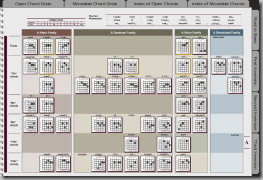
This week I’m starting with the First Mode of the Major Scale: The Ionian Mode, working on the Standard, 3-Notes/String and the lmaj7 Arpeggio in all seven patterns. I’m using Guy’s Scales Modes and Arpeggios (see photo below) lesson plan which is very easy to follow but is also a complete comprehensive presentation that leverages a very similar grid structure in the context of scales that we’ll see in Guy’s Grids (see photo below) in a later post when we cover chords and chord patterns.

Guys_ScalesModesArpeggios_thumb Guys-Grids-Chords-Structure_thumb1


EXAMPLE: First Mode of the Major Scale

This is a quick view of what the typical instruction page looks like in this lesson plan. It is very easy to read and follow no matter what your skill level may be.

First-Mode-Major-Scale-2_thumb9


Billy-Gibbons-035_thumb

The 1st weekend I chose the intro to the ZZ Top song “La Grange”. That guitar intro is one of the most well known guitar pieces in Rock-n’-Roll history and I wanted to learn how to play it correctly, and I did.  I also learned some of the guitar parts throughout the song, so that made me very happy.

I recommend you do the same; it was time well spent.


Week No. 2: The Blues Scale (Box’s 1-5) in Review:

I’ve often had questions regarding what are commonly called “the modes”. These refer to the Ionian, Dorian, Phrygian, Lydian, Mixolydian, Aeolian and Locrian modes of the traditional diatonic major scale. If this makes no sense to you, it probably doesn’t have to. Modes are actually very simply, and mostly on a guitar they tend to serve as nothing more than “boxes” for the diatonic scale.

MusicianByNight_02Small

As it turns out, if you combine the major and minor pentatonic scales, without the blue notes involved, you’ll get the notes in the mixolydian mode. The mixolydian mode is the mode you always want to use over 7th chords, which are the main chords in a blues song. So you’re already playing modes and didn’t even know it, if you’re familiar with the major modes listed above.

Once you add the blue notes to the pentatonic scales, thus turning them into “blues scales”, you’ve also added the blues notes to the mixolydian mode and there really isn’t any more to it. Sorry if you are disappointed.

You’ll sometimes see this scale called the “composite blues scale” on the internet. it’s nothing you don’t already know, just a name that has caught on through the web. And again, it’s just a mixolydian mode with the blue notes, which is just the major and minor blues scales (boxes 1 and 2) put together. Once again, nothing you don’t already know, right ?


Sunday, August 7th, 2011

Beyond Blues: The Composite Blues Scale

by Jeff McErlain

As we know, a standard blues progression is made up of three dominant-7th chords—the I, IV, and V. This month, we’re going to look at some cool ways to spice up the I chord. To make things easier, we’ll stick to the key of A, so our I chord will be A7. A quick and simple way to spice up that chord is by mixing two very familiar scales, the major and minor blues scales. If we were to look at the formula for this scale it would be root–b3–4–b5–5–b7.

What makes this scale very cool is the added b5 or “blue note.” The b5 adds some chromaticism to the scale, which it doesn’t have otherwise. A great sound is to really play up the chromaticism in a lick. I really love the rub and tension those notes can add to a line. If you haven’t spent some quality time with the blues scale, I suggest you do!MusicianByNight_03Small

An A7 chord is spelled A–C#–E–G or root–3–5–b7. If we look at our minor blues scale we can see that it does not contain a very important note of the chord, the natural 3rd or C#. Although the scale sounds great, it does have some room to expand. A simple option to play over the A7 chord is the A major blues scale. This scale consists of A–B–C–C#–E–F# and its formula is root–2–b3–3–4–6. This scale now includes the natural 3rd (C#).

Fig. 1 is called the composite blues scale; 

That’s a lot of notes to think about. Here we have A–B–C–C#–D–Eb–E–F#–G, or root–2–b3–3–4–b5–5–6–b7. That’s nine notes.

Before you get overloaded, let’s take a closer look at all the harmonic goodness going on inside here. First, we have a series of half-steps that go from B to E, and that’s where the fun lies as we can see in Fig. 2. We can use this same technique to create a classic-sounding blues turnaround, as shown in Fig. 3. To get a jazzier sound, I used all the half-steps found in this scale to create a classic bop lick with a bluesy twist as seen in Fig. 4.

Download Example 2 Audio...

Download Example 3 Audio...

Download Example 4 Audio...

As you can see, the composite blues scale has many exciting possibilities, and I have only scratched the surface here. The thing to remember—and the key to breaking this down—is that all you are doing is mixing the major and minor blues scales, nothing more! So if you are feeling overwhelmed at the many options and sounds, start with something as simple as adding one new note to your minor blues scale. The first note I’d suggest is the natural 3rd (C#), which will put you on the right track. Remember, we can use these licks on the I chord of the blues, but be careful of that C# against the IV chord (D7)—it can really clash. What to do? Just don’t play it.


Week No. 3: The Major or Dorian Scale in Review;

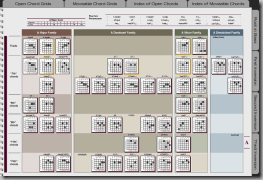
The Second Mode of the Major Scale: The Dorian Mode, still working on the Standard, 3-Notes/String and the imaj7 Arpeggio in all seven patterns. Remember, I’m using Guy’s Scales Modes and Arpeggios (see photo #1) lesson plan which is very easy to follow but is also a complete comprehensive presentation that leverages a very similar grid structure in the context of scales that we’ll see in Guy’s Grids (see photo #2) in a later post when we cover chords and chord patterns.

Guys_ScalesModesArpeggios_thumb_thum Guys-Grids-Chords-Structure_thumb1_t

                  Photo #1                                              Photo #2


The Dorian Scale is outlined on Page 14 of Guy’s Scales, Modes & Arpeggios. I suggest you order the program so you have it to follow along with me; it is a fabulous lesson plan for us guitarists. Concentrate your efforts on the 3-Notes/String and the im7 Arpeggio’s. Play them over and over while you continue to play the Week One and Two Lesson Plan’s. I suggest you take one key and learn the Ionian Scale, then learn the Dorian Scale in the same key. Then practice tying both scales together and play them against a song recorded on CD.

MusicianByNight_03Small

I hope you follow along with me and keep working these scales. I know for a fact that learning the scales and identifying with the fingerboard are the two most important issues when training to become a professional guitarist. I’ll never stop practicing the major scales, of that I am sure.

Hope your Sunday evening is great and don’t forget to give your kids a hug. I have a few good post’s coming up that I’ve been working on so until next time.

Don’t be blue . . . . .

Musician By Night

Sunday, August 14, 2011

My Weekend Workout / Week Three:

DSC01037

In this third week of the program, the concentration is going to remain on the major scales, but we’re moving on to the second mode and more focus will be given to all the arpeggios.  Learning the Second Mode of the Major Scale; Dorian Mode or (Dorian Scale) and then concentrating on the im7 Arpeggio’s will help build our fingerboard vocabulary.  Please remember, I’m taking this rather slow because I want to drill it into me.  If you are bored with my plan, don’t knock it; just move on to another lesson plan that best fits your skill level.

Let’s get started;

Week No. 3: The Major Scale (Dorian Mode or Dorian Scale)

The Second Mode of the Major Scale: The Dorian Mode, still working on the Standard, 3-Notes/String and the imaj7 Arpeggio in all seven patterns.  Remember, I’m using Guy’s Scales Modes and Arpeggios (see photo #1) lesson plan which is very easy to follow but is also a complete comprehensive presentation that leverages a very similar grid structure in the context of scales that we’ll see in Guy’s Grids (see photo #2) in a later post when we cover chords and chord patterns.

Guys_ScalesModesArpeggios_thumb Guys-Grids-Chords-Structure_thumb1

                 Photo #1                                                  Photo #2


The Dorian Scale is outlined on Page 14 of Guy’s Scales, Modes & Arpeggios.  I suggest you order the program so you have it to follow along with me; it is a fabulous lesson plan for us guitarists. Concentrate your efforts on the 3-Notes/String and the im7 Arpeggio’s.  Play them over and over while you continue to play the Week One and Two Lesson Plan’s.  I suggest you take one key and learn the Ionian Scale, then learn the Dorian Scale in the same key.  Then practice tying both scales together and play them against a song recorded on CD.

I hope you follow along with me and keep working these scales.  I know for a fact that learning the scales and identifying with the fingerboard are the two most important issues when training to become a professional guitarist.  I’ll never stop practicing the major scales, I know that for a fact.

Have a great evening and don’t forget to give your kids a hug.  I have a few good post’s coming up that I’ve been working on so until next time. 

Bob . . . . .  

MusicianByNight_03Small


Monday, August 8, 2011

This is Ground Control to Major Scales!

I’ve been reading several blogs now, all related to music in one way or another.  Whether it be about guitars, amplifiers and effects pedals or about guitar lessons or guitar repairs, I’m now a blogger.  Well during one of my blog tours, I ran into one of the most motivating posts that just happen to tie right into what I was talking about in my post just yesterday when I talked about the importance of learning the major scales inside and out and up and down the neck of your guitar.

The following is a guest post written by a guest, I hope you enjoy it. 

Written by: Guest Post on December 1, 2010.

This is Ground Control!

While visiting my family over the weekend, my younger cousin Jonah brought his guitar to my parents house. (Hey Jonah, sounding really good my man!) The following is some of the things we worked on. Firstly, I mentioned the importance of MELODY. Our leads/solos should revolve around a melody or theme. It’s a great idea to learn as many melodies as possible on the guitar, ESPECIALLY super-simple children songs.

This Serves Two Purposes:

1. By learning lots of melodies, you will develop a better sense of where notes are on the neck.

2. It will help you to sharpen your ear, and improve your sense of melody.

This familiar melody as shown is played on the high E string and the B string.

e|–5-3-2—–0-2–

b|——–5-3—–3-

Figure out the rest of the phrase on your own!

Here is another seasonal melody also played on the first two (high) strings.

e|—-3-3-5-3-2-0-0-0-5-5-7-5-3-2–

b|–3————————————-3

Again try and work out the endings.

[If you are REALLY STUCK, email me for the ‘answers.’]

Try and play as many melodies as you can on the guitar, you may want to keep a running list of these melodies for future reference.

Another concept we worked on was playing scales on a SINGLE STRING. While not as efficient or even practical for actual playing, it makes for excellent practice. It also serves the purpose of getting familiar with the intervals of the scale, neatly laid out on a single string.

Here is the MAJOR SCALE!

|–0-2-4-5-7-9-11-12-14-16-17-19-21-23-24

—w-w-h-w-w-w-h-|-w-w—h—w-w-w—h–

All scales are simply a series of WHOLE STEPS (two frets), and HALF STEPS (one fret) between notes. The type/sound of scale is determined by where these HALF steps occur. The half step/one fret interval (in a major scale) is between the 3rd and 4th notes, and between the 7th and 8th/ OCTAVE.

Guitar   Since this is all on a single string, you can play this pattern on any/all of the open strings. The first note is the OPEN STRING, the KEY of the scale is the same as the string you are on, E B G D A or E. The ROOT is 0, the OCTAVE is the 12th fret, and the Second octave is the 24th fret.

Take Note of This One!

There are just two intervals that are one fret (half step) apart; the rest are two frets (whole step) apart. This applies to MAJOR, MINOR and any other MODE of scales. So when playing melodies or riffs within the scales and you aren’t sure if the next note is one fret or two frets away, you have 5 in 7 chance that it is two frets.

Understanding the major scale and it’s intervals will help you more than any single piece of knowledge – the mechanics of all western tonal music is based on the MAJOR SCALE. Enjoy your leftover turkey and dive into the major scale!


I hope you enjoyed this post, I know I did and it cleared up a lot of questions I had about the major scale.  Hopefully you’ve learned a little more about the use of the major scale. 

Have a great day tomorrow and don’t forget to give your kids a big hug.  Until next time . . . . . . . . . . .

Bob

GuitarNthusiast_LOGO