I stumbled upon this Interview with Eric Johnson by Ivan Chopik of the Guitar Messenger and just had to share it with you.
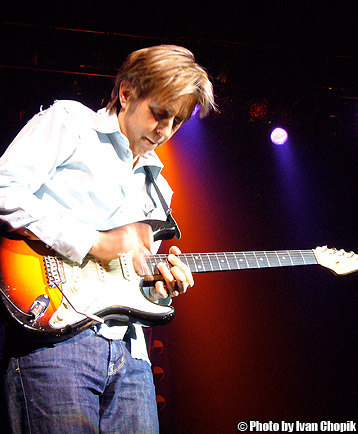
Eric Johnson is a remarkable artist who makes no compromises with any aspect of his music – from the well-crafted songwriting that spans various styles, to the carefully-selected chord voicings and wide-interval leads that are always delivered with some of the most exceptional tones in the business.
Eric first gained widespread success with his 1991 Grammy-award winning single ‘Cliffs of Dover’ from the platinum-selling album Ah Via Musicom. Since then Eric has released a number of acclaimed albums and live performance DVDs, as well as a series of comprehensive instructional videos that dissect his style and influences. He was also featured on a number of G3 tours, including the first ever G3 tour in 1996 with Joe Satriani and Steve Vai.
In 2008, Eric joined a group of other renowned musicians in celebrating the music of Jimi Hendrix as a part of the Experience Hendrix tour. I had the opportunity to speak with him at the Boston, MA stop of the tour:
IC: How are you?
EJ: I’m good, man, thanks. Thanks for coming by.
IC: For sure. What’s going on right now in your world?
EJ: Just doing this Hendrix tour for fun. It’s like three and a half weeks, which is mainly East Coast and West Coast.
IC: How’s it been so far?
EJ: It’s good. I’m hanging out with all of these guys, we’re all getting along great, all friends. Everybody’s really a nice player in all sorts of different ways. Everybody has a different style, so it adds a different facet to the whole thing. It’s kinda more just a fun thing. You know, we get together and just jam and play wonderful music by Jimi Hendrix and just have fun with it.
IC: How close do you stay to the original material? I’m sure you put your own spin on it.
Click play above to watch the video of this interview.
EJ: You know, in my set, some of the stuff I try to play just like the record. Just because to me, it’s become so historical – the whole musical… like a song. Some of his leads were so lyrical, that I figure they’re part of the composition. Not in the true sense – I guess they were improvised, but for me some of it’s fun to sort of attempt to recreate that vibe, because it’s really cool. But then I’ll veer off, as well.
IC: On a day like today, after you’re done with the interviews and press, what goes on right before the show? Do you have any rituals or anything that you do before you go on?
EJ: You know, I’ll just kind of practice a little bit, and just get ready – tune up and make sure everything’s working right. Nothing really, other than just playing a little bit. That’s all.
IC: Cool. New record: any titles yet in the works?
EJ: I’m still thinking about what I’m gonna call it, but I’m probably 2/3 finished with it, 3/4 finished with it. We’re gonna have it out sometime early next year.
IC: Is this also on Favored Nations?
EJ: No, it’s not. I don’t think so, no.
IC: You’ve moved on?
EJ: Yeah, our deal expired, so now we’re gonna probably work with another label. We’re negotiating with some people right now.
IC: How in touch are you with that aspect of your career?
EJ: Well, I talk to my manager and he runs everything by me, and lets me know what the options are, and what the opportunities are. But I leave a lot of it to him.
IC: Are you recording this in your home studio?

Eric Johnson and Billy Cox - Jimi Hendrix's Bassist
EJ: I am, yeah. I started building this place about fifteen years ago, and I’ve just slowly just built it up. It was basically usable within the first year, but we’ve kind of finished it off, and built the control room up and stuff. So this is the first record where I’ve literally done the whole record in the finished studio.
IC: Is this in your house?
EJ: No, it’s not in my house.
IC: Oh, you’ve got a separate place?
EJ: Yeah, it’s a separate place.
IC: I would imagine, being a tone purist, that you have a lot of analog equipment there.
EJ: I do have some analog gear. Right now, we’re doing this record on… I’ve kind of really enjoyed the Nuendo stuff. To me, I like the way it sounds. Pro Tools has it’s own sound, but to me, the Nuendo stuff is a little bit more analog sounding. So I’m kind of digging on using that right now. But I still have analog machines. On this record, I really haven’t used the analog machines. I’m dealing more with just working on the songs, I haven’t really given it much thought.
IC: When you say that you’re 3/4 of the way through – is that recording also, or have you just been writing up to this point?
EJ: No, no, I’ve got all of the tracks cut and probably 2/3 of the overdubs done. I’ve got maybe 30% of the overdubs left to do on it, and I’ve gotta get it mixed. So in another ten or twenty years, I’ll be done (laughs).
IC: Speaking of that, you’ve mentioned before that you took so long to work out each detail – from the tone to the performance and takes. And you also mentioned that you’ve kinda relaxed over the last few years on that, trying to get more things out.
EJ: Yeah, and this record’s… Bloom [Eric’s 2005 release] was a lot quicker than Venus Isle, this record’s a lot quicker than Bloom. It’s getting quicker all the time. I’ve still spent like, eleven months on it – not solid, but off and on. I still feel that that’s… well, there’s no real right or wrong to it, but my goal is to spend less time on records. So the next record I’m gonna spend less time on.

I want to get it where it’s more where you do a record in a few months. I want to get back into that. It’s a slow thing for me, I mean, I’m getting there eventually. This one still took longer than I wanted it to, but it’s a lot quicker than the other ones were (laughs). So I think I’m walking in the right direction, at least! I’m kind of trying to build on that.
There’s more performances on it, but getting in the studio is a challenge for me, because it’s so austere. As soon as I get in there and you put the mic an inch away from the cabinet, it’s like ‘What happened? It sounded so great at the gig.’ There you’ve got the audience to feed off of. Some people, they’re just a natural in the studio. I have trouble getting that… where you just forget about everything and just play. I get kind of, a little bit…
IC: Red light syndrome?
EJ: Yeah, a little bit. It’s getting better, though. I just want to be patient with it, and as long as I’m walking in the right direction, I think I’ll get there.
IC: What was the writing process for this one like, and musically how would you say this album is different from Bloom?
EJ: It’s a little bit more performance-oriented on this record. I cut like 22 tunes, and then I ended up finishing up about twelve or thirteen, something like that. It’s just a little bit more playing, it’s not so much pieced together. It’s pretty song-oriented – we do have some blowing sections on it, but it’s a lot of songs.
IC: I’ve noticed a pull in that direction in general over the last couple of years, especially checking out the new instructional video. I noticed actually that you hold back a lot of times. So I wasn’t sure if that was so people could actually comprehend what you’re doing and kind of catch up, or whether or not you’re consciously holding back on your playing a little bit.
EJ: To be really honest, when I listen to my records, I think I hold back a little too much. But when I listen to my live gigs, I think I noodle around too much. I mean, just being honest.
IC: Really? Wow.
EJ: Yeah, I think. Well, it depends on what your clientele is. If it’s just guitarists coming to hear you, then maybe there’s a different parameter of response. I think there’s a middle ground there I’m still searching for – to play with a lot of energy and ferocity, but in a musical sense. I think sometimes I’ll pull back if I just feel like it’s not musical enough, you know? I’m kind of searching for that. You know, and I’m kinda searching for that, and also a continuum of the guitar: where do you take electric guitar and try to be innovative, or play lyrically? I guess sometimes I… ‘Well, I’ll just do this instead of playing a bunch of just noodling around, or squiddly-whatever’ (laughs). Squiddly-squiddly-squiddly!

Eric Johnson playing one of his Signature Model, Fender American Deluxe Stratocasters
IC: Tone is such a hard thing to get right every single time, and keep consistent… Assuming you had the perfect tone, everything was exactly how you would like it, how would you describe in your own words a perfect solo?
EJ: A perfect solo? Well, you know, you get in a lot of trouble for using the word perfect – I do. So I really try to stay away from that. In a lot of different idioms it’s just part of the package. It’s not the most important thing, obviously. But if you listen to violin players or classical musicians, and you study what they’re trying to do, or you listen to them run through their repertoire of practice – there’s no question that there’s a little bit more of an embraceable atmosphere to go for that level. Do you know what I’m saying?
But for some reason, if you get on guitar, that goal of playing like Yo-Yo Ma or whatever, or playing with the kind of tone, you know, the really cultivated thing, it’s like ‘Oh, no, it’s not…’ So I hate to get into that arena of using that word, because it can cause semantical discourse, I guess you would say.
IC: Sure.
EJ: But to me, I love hearing classical players play where they’re just skimming off the fretboard, and there’s this killer tone – it’s beautiful. So to me, as close to that as I can get. But above and beyond that is something that has content, and is soulful, and really creates an emotion – where the listener is moved. And they’ll be moved especially if you’re moved, and you’ll be moved more if you find a terrain that’s new and exciting and different, you know, a little bit fresh.
IC: How has your vision of guitar playing, and what you’re striving for musically in general changed over the years?
EJ: I’m just trying to learn more about music, learn how to play with more melody, more lyricism – play through the changes more, not be stuck in just patterns. I’ve been, as a lot of people are, stuck in patterns. You get stuck in a certain alphabet, and if you can kind of lift yourself out of that, you can keep the door open, keep growing. So that’s what I’m trying to do. And I’m pretty happy with my sound now. I mean, I’ve kind of come off of that a little bit, and I think I’ve got it where it’s kinda working. It’s definable, and it’s a little more consistent now. I’ve tried to simplify it a little bit, so I can get that. But, yeah, I feel like the road is being blazed, and it’s just a matter of walking the long walk now.
IC: You just mentioned you simplified things a little bit. How has your rig changed over the last couple of years? I noticed in Bloom there was a pretty distinct tonal change from the older records. It was a little bit more round, more in your face…
EJ: Yeah, the Bloom record I used a lot of 50 watt amps on. Now I’ve kind of gone back to the 100s a little bit. Yeah, I don’t know, just kind of experimenting with different stuff. I’m trying to get it to where it’s not obtrusive, but still up front, you know – has a power and a solidarity to it without being offensive. Kind of a balance there.

Eric's pedalboard on the 2008 Experience Hendrix Tour
IC: Is the pedal setup still the same?
EJ: Yeah, for the most part. I’ve kind of quit… I had this effects rig I was using outside of my amps, and it just got really complicated, so I just went back to just using an Echoplex in my rig again now.
IC: Oh, really? Were you using rack equipment for a while?
EJ: Yeah, well, I was using it after the amp, like mic’ed – like in a studio kind of deal, where I’d have the effects rig coming back. I played a couple of gigs where the effects were as loud as the guitar note, because they were trying to find the faders, so it was a disaster.
IC: You lose some of the control.
EJ: Oh, man, it was horrible. So I was like ‘I’m not gonna do that anymore.’ So I just started using the old Echoplex again.
IC: So do you have a couple of those things laying around?
EJ: I do, yeah, I don’t know how much longer they’re gonna last. I don’t think they were ever meant to last this long. They’re kinda like a tired hamster, but we’ll see what happens.

Fulton-Webb Amp w/ a Marshall 4-12” Speaker Cabinet . . custom-built by Bill Webb
IC: Do you take a lot of your vintage stuff out on the road?
EJ: Yeah, I do.
IC: Marshalls, too?
EJ: Yeah. There’s a guy I work with – Bill Webb. He builds Fulton-Webb amps, and I have one of his amps out with me. It’s a really nice amp. He builds old-school stuff that’s brand new, and I like that. But other than that, I’m using a lot of just the old stuff.
IC: What about the guitars? Are you bringing any of your signature models on this tour?
EJ: Yeah, a couple of them. I’ll be playing one tonight.
IC: Yeah? Talking about Strats, I’d say that’s your No. 1 guitar. I see you a lot with the ES-335, too, but I associate you more with Strats. So looking at a Strat, what makes, to you, the perfect Strat? Or, let’s stay away from perfect now (laughs).
EJ: (laughs) One that has been cleaned by the military, and smells real pretty. Nobody’s looked at it or thought about it – thinking about it will mess it up. So we leave it in the attic, we don’t talk about it, as the guy in Spinal Tap says.
IC: An ideal Strat… what about your signature model is missing from the ideal Strat, or is that it?
EJ: Well, to me, I like the Strat just ‘cause it does… if I had to have something that would get a crunchier rhythm and a lead tone – if you try to cover all the bases, I can do it with a Strat. With a Gibson, I can get… I would have to say I can probably get a better lead tone with a Gibson than I can with a Strat, but I can’t get the rhythm tone I want. It leans one way more, whereas a Strat kind of splits the difference, as everybody knows.
Everybody knows it, and that’s why they’re so popular. But the bridge pickup can be a problem for me, because they’re not strong enough. But if they get too strong, you lose that rhythm tone. To me a great Strat would be one that sounds real twangy, and can sound like Don Rich from Buck Owens or Hendrix from ‘The Wind Cries Mary,’ but you flip it over to the bridge pickup and it sounds like ‘Wheels Of Fire,’ like Clapton. I mean, that would be… (laughs) If I get to dream the exact thing I want – and maybe a special switch for that ‘Birds Of Fire’ McLaughlin tone. I mean, I’m not asking for too much. While I’m at it, maybe another switch that would go to Wes Montgomery, let’s see…
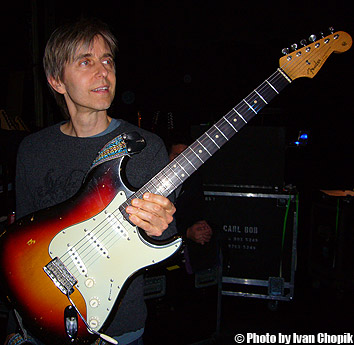
Eric Johnson holding his Signature Model ‘57 Fender American Deluxe Stratocaster
IC: I understand you’re an accomplished pianist, as well.
EJ: I do a lot of the writing on piano.
IC: You actually started with piano, right?
EJ: Yeah, I did.
IC: Is it usually progressions or melodies or lyrics [that come first in your writing]?
EJ: It’s usually music first, and then the melody comes out of it, and the lyrics always come last. The lyrics are always, like: ‘Ok, it’s time to go do it.’
IC: A typical day, you’re at home, you’re not necessarily about to go on tour – more of a typical relaxed day. What kind of stuff do you do?
EJ: Well, the first thing I do is grab a cup of tea, so I can wake up. Then, I don’t know – check email, call friends, go to the lake if I can; go waterskiing if it’s hot enough, or go wet biking. That’s what I like to do, I like to got to the lake, go for walks, I like to jog, go hear music if there’s somebody really good playing – but otherwise I usually have to do a few things around the house, I just go to the studio and practice, or record or something.
IC: What do you like to listen to nowadays? Are there any new artists that you’ve discovered?
EJ: Yeah, there is. Every time I think about it… I’ll think of ‘em after you leave. Oh, Oz Noy – I’ve been listening to him a lot lately. In fact, I’m going to go see him play on Monday night in New York. Yeah, I’ve been digging him. He’s really great. I’ve been listening to some old Danny Gatton a little bit, I was listening to Jerry Reed yesterday. These are all brand new players, right (laughs)? Well, I hadn’t even heard of Oz Noy until a couple of months ago – I like him.
IC: This always yields interesting, or at least different results: tell me something that you’ve never mentioned before in an interview. It can be anything you want – an experience, a story, or something that you do.
EJ: Wow, what would that be? God, I think I’ve always talked about everything so many times. That’s another one I’ll think about after you all leave… I fell through a stage once! I fell through right all the way through the stage. They had an opening in the stage for some kind of theatrical thing, and they forgot to put the trap door over it. I was playing along, and fell through it, and caught myself. Fortunately I didn’t wreck my guitar.

IC: No injuries, right?
EJ: No, it was great. I mean, that’s something different, I guess.
IC: A bit of an adrenaline rush, I would assume.
EJ: It was horrible, yeah. The drummer laughed so hard he fell of his stool. He thought ‘Oh, this is crazy!’ and he totally fell apart.
IC: When was that?
EJ: Oh, man that was twenty years ago, maybe 25 years ago. A long time ago, yeah…
IC: Is there any advice that you can give to young players aspiring to become full-time musicians?
EJ: I think just have fun with the instrument. I think maybe the most important thing is to play what really gives you joy on the guitar, and couple that with pushing yourself. You have to be discriminate, and you have to push yourself, I think, and that’s not always going to feel comfortable. In fact, most of the time it’ll be uncomfortable. But it’s a sweet kind of pain, and I think you have to make peace with that sweet pain, and realize that’s actually sweeter than it is painful, you know what I mean?
It’s really easy to get caught in the painful side of it, and have that thwart your trajectory. But if you don’t try to judge it too much, and just kind of go through it… it’s the same I guess with an athlete, you know, with the burning and stuff. So you make peace with that sweet pain, and you push yourself very discerningly and monitor, you know, listen to yourself on recordings, and be demanding of yourself, in a loving way. But encapsulated in all of that, chase that passion and that dream of the notes and music that makes your heart sing. Because that’s really the fuel that’s gonna make you stay with it and keep with it, and progress. If you have that, then you have this special dynamo that’ll make you want to keep connected.
So I think it’s a combination of those two things. And without it being in your mindset to be ‘good,’ because that’s such a fleeting thing, and that does more harm than good. Or the competitive [nature] of ‘Am I as good as this guy?’ and all of this stuff, all of that mental luggage. Without even dealing with any of that, with just using those other recipes – it’s the quickest, shortest cut to getting good.
IC: Did you find yourself, when you were younger, being more competitive, and being perhaps more aggressive – trying to get out onto the scene?
EJ: Yeah, and I think it comes even with me now, too, and not in a vicious way, but in a way where you start… I mean, everybody has times where they have self-doubts or insecurities – if you haven’t practiced it enough, or you’re wondering where you’re going, or if you’ve developed anything mind-blowingly new in the last year.
So you start wondering, and your mind starts turning, and I think all that relating yourself to other people, or trying to balance out yourself to other people basically comes from not being sure enough with yourself. Because there’s a difference between having an ego and having confidence. They seem like ‘Oh, they’re the same,’ but they’re not.

Ivan Chopik with Eric Johnson in 2008
They’re actually exactly opposite. One’s coming from insecurity, and one’s coming from a self-realized security: that you’re on a path, and you’re doing your best, and you’re using your own thing. It’s really that: developing a healthy self-supportive confidence, and then all that other stuff is not an issue, because that stuff is not a usable currency. Because you’re confident, and you’re enjoying your playing, so that [other] currency is useless.
IC: The reasons, and your aspirations and goals – have they changed over the years? The reasons why you’re out here making music?
EJ: My goal is… I’m really getting to a place where I’m starting to get this signature trademark sound, that’s a little bit removed from what the guitar would be if I hadn’t of manipulated it a little bit. I’m kind of happy with that, because to me it’s getting some of that classical violin vibe, you know, and that’s what I wanted – not to sound like a violin, but it’s the harmonic tonal purity that a violin has, or an instrument like that. I’ve wanted to inculcate some of that into guitar.
To me [the goal] now is to try to come up with some fresh guitar music that can utilize that, you know, like a magic carpet and go somewhere. That’s what I really want to do… so that it’s pleasing to hear, and lifts you and makes you feel good. Because there’s just been so much guitar stuff done, that you have to find a niche that you think will project you.
IC: Eric, thank you very much. It’s been a pleasure.
EJ: You’re welcome. Thanks, Ivan – I appreciate it.
Special thanks to Chris Dingman for the transcription of this interview.

ABOUT IVAN CHOPIK
Ivan Chopik founded Guitar Messenger in the Fall of 2007 and is currently running the online magazine as Editor-in-Chief, webmaster, and writer. He is also a guitarist, composer, and producer who graduated from Berklee College of Music in May 2010 with a Bachelor of Music degree in Guitar Performance and Music Business & Management.
View other posts by Ivan Chopik
Visit Ivan Chopik's Website: http://www.myspace.com/ivanchopik
I hope you enjoyed this interview with Eric Johnson. In this New Year, I have resolved to broaden my research and expand on my sources in order to uncover and feature talented musicians that I am currently unfamiliar with. I hope that you will enjoy reading these posts as much as I enjoy working on them. And if there is someone that you would like to learn more about, leave me a comment; I welcome suggestions!
Until next time ~
Musician By Night . . .


